

Cooling! Experiments With My MGA’s Cooling System – Part 1

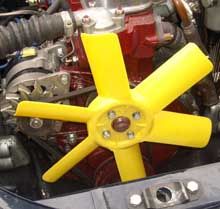 I have never had any particular problem with the cooling system on my MGA. Since I got this car over six years ago, it has always run relatively cool with the standard engine driven metal fan.
The water temperature was normally around 175, it never went much above 185; and the only time I ever suffered from any overheating was when I first got the car when one of the short air hoses fell off in front of the radiator obstructing the airflow slightly.
So you may say, If it wasn`t broke, why fix it?
Well my problem is probably that I read too many articles in the MGA forums and on MGA Guru etc., and sometimes (well maybe most times!) they get me thinking, “I wonder if that would be better for my car too?”
In 2012 I was preparing the car for a tough journey to the Alps on which we would be climbing some long passes up to 10,000 feet, and so I thought that fitting a more efficient fan would be a worthwhile modification.
As part of the preparation I also fitted an oil cooler, but not in the normal place in front of the radiator. I have always wondered about the logic of fitting the oil cooler there, my thoughts being that although it would cool the oil, it must at the same time put some of that heat back into the engine cooling system. Fortunately my car has a Sebring style front valance with no bumpers, so I made use of this by mounting the oil cooler beneath the radiator duct and then cut a vent into the front valance to allow air to flow through to it. This meant that engine heat removed by the oil cooler would vent out under the car and not go back into the radiator. I also fitted a thermostatic by pass valve into the oil cooler circuit, which only allowed the oil through the cooler when it reached 195 degrees so that it wouldn’t over cool it.
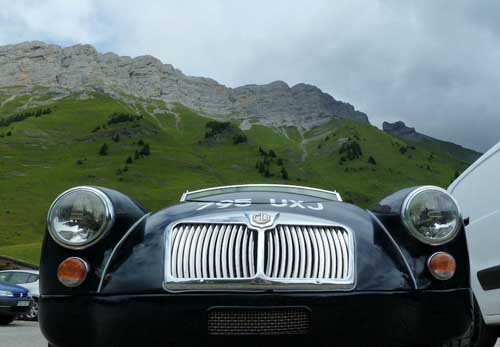
PLASTIC FANS
I read in the forums about some aftermarket plastic fans, which had much better fan blade designs than the standard MGA fan blade (which is basically just an angled piece of metal). When I looked into these, I found that there were a few types available; the Moss six blade fan with symmetrical blades, the Moss seven blade asymmetrical design, and also the NTG six blade fan.
Opinions were that the Moss plastic fans had quite flexible blades, which in high temperatures, could actually bend forwards slightly, enough for the tips to catch on the radiator core. Also there was a possibility that if the car was driven through water deep enough to reach the engine fan, the blades could bite into the water and bend forwards into the radiator. So I opted to try the NTG fan which apparently had the following advantages:
- A more rigid blade construction with little or no flex.
- The blades are broader with a more efficient aerodynamic design to move much more air.
- The blade diameter is almost 1” larger which also increases the volume of air being moved.
To make fitting easier, I opted to remove the radiator which greatly improved access to the fan and also meant that I kept most of the skin on my knuckles. The slightly larger fan diameter meant that the outer edge of the blades would become really close to the metal finger guard on the back of the radiator’s top tank; so I carefully bent the guard upwards by ¼” and this then produced plenty of clearance. Also my radiator had already been spaced forwards by approximately ¼” to give more clearance for the slightly longer MGB water pump on my car and this provides plenty of clearance between the fan blades and the radiator cooling fins.
When I first ran the engine with the NTG fan, I noticed that the flow of air had increased significantly from what it was before. It became obvious just how much more air was being moved because the first time I revved the engine with my head under the bonnet, it actually blew my baseball cap off!
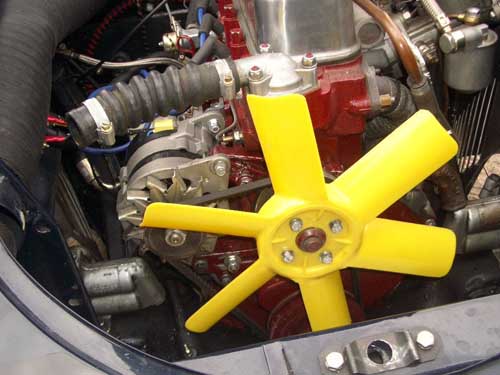
It certainly worked really well, the running temperature dropped by 10 degrees F to approx. 165 most of the time and our journey over the Alps also went really well with the engine temp never really getting far above the high 180s even on the steep climbs.
But the downside was the noise that the fan creates, I should have realised that moving more air would most likely mean creating much more noise! I think that this is mostly due to the square end design of the blades and the larger diameter. The howling noise that it makes at higher revs is more reminiscent of a passing double-decker bus, which is just not a great sound for a sports car.
I lived with this fan for a couple of years and then I booked a visit to Peter Burgess’ rolling road dynamometer for an engine tune up. During this, Peter advised me that my big fan was probably using up to five bhp at high rpms; so this made me decide to search for other alternatives.
The first one I found was the Flexolite fan, an American design having metal blades which “feather” at higher revs, the idea being that the fan only really needs to push max airflow through the radiator at tick-over or at low road speeds. At higher revs when the car is moving, there is plenty of speed generated air flow through the radiator, and the Flexolite fan blades feather (flatten) and push less air, so this will reduce fuel consumption, reduce fan noise, and release a few extra horsepower from the engine that was previously being used to power the fan. However, the Flexolite doesn`t appear to be available in the UK and no one in the States seemed to know if there was a model that would fit the B-Series engine.
I also looked to see if there was any type of viscous coupled fan that could be made to fit the B-Series; these are fans, which have a sort of oil filled clutch mechanism in the hub. The principle being that at low revs the engine driven hub transmits all of its rotation into the fan blades, but as the revs increase, the clutch slips and therefore the fan blades rotate slower than the hub and save on wasted energy. This used to be the type of fan fitted as original equipment to Ford Capris and Escorts, etc. before electric fans came into regular usage. Once again though, there was little or no information on this type of fan being available for the B-Series and the few experts that I asked, advised me against fitting one based on reliability issues.
So, I next considered fitting the Moss asymmetric seven bladed fan, which apparently runs much quieter than my NTG fan because of its round ended blades and the uneven blade spacing, which significantly reduces fan noise.
Cooling Part 2: The Moss Seven Blade Design and Electric Fans will be posted on the website in due course.

Comment by: Fred Woller
hi gang ,its been a long time since i’ve been back in the loop.Now that the world is on lockdown. Just thought i’d let you all know that my aluminum radiator and 7 blade fan and shrowd set up are still working wonderfully with a running temp of 175 to 185 . now my biggest problem is keeping the bugs out of my mouth while i smile driving down the road. Hope you can all now get to those little repairs on your A’s now that you have to stay home alone. Social distancing
Comment by: Colyn Firth
Steven, did I see somewhere that you couldn`t fit twin fans onto your radiator?
My fans overlap the outside edges of the rad by about 1/2″ or so but it is no problem.
If you wish I can send you some pictures of how my fans fit.
my email address is colynfirth@msn.com
Cheers
Colyn
Comment by: Steven G Smith
Thanks Colyn that helps, I will make sure I put the engine driven fan back on when I put it back together. By the way, I almost almost blew the engine because I lost all fluid driving home from a car/airplane show this past weekend. I lost all the fluid and the temperature maxed out in just about 4 minutes. I pulled over and luckily I caught it in time. By the way I took best in show and was surprised since it was my first competitive show. Thanks again for your comments about your experience with an electric fan. Steve
Comment by: Colyn Firth
Hi Steven
I found that a single 10 ” fan (mine was a Revotec) didnt really stay on top of the cooling requirements of my MGA on its own.
I was regularly getting temperatures of over 200 degrees on long climbs in the hills and when I became stuck in traffic even here in the UK.
I found that I could keep the temperature under more control if I switched on the manual over-ride switch in advance of any long climbs or traffic jams and it would usually then keep the temperature below 200F.
That was a lot hotter than it ran before with the big plastic NTG fan and so I wasn`t really so happy with it.
I think a single electric fan controlled by a thermostatic switch is probably best used in conjunction with an engine driven fan.
Its a pity you can`t fit two 8″ fans as they are perfect for the MGA. My car normally runs at 185 degrees( or lower in cooler weather) and the twin-fans only come on when I am stuck in traffic. They now switch on at 195 degrees and off again at 185 degrees and so they almost never switch on when the car is moving.
I used to have the fans come on at 205 degrees and off at 190 because engine driven fans use up to around 5 or 6 bhp.
The engine I had fitted at the time developed 106 bhp and so I was happier to have that 6 bhp available to power the car and not the fan.
Since I wrote the article I have fitted a 1950cc 5-bearing engine which develops over 140 bhp and the twin fans still have no problem keeping the temperature under control. Also, with so much more power available I am not now so concerned about wasting 5 or 6 bhp grin
To be honest, there is so much extra cooling capacity in the twin-fans set up that you could adjust the fans thermostat to keep the engine temperature down to around 165 to 170 degrees if you really wanted to. (Not recommended)
Hope this helps
Cheers
Colyn
Comment by: Steven G Smith
I see it is pretty quick so the first one must have been lost in cyberspace. My question is that I am in the process of changing my water pump, it has a leak and while doing so I am going to have my radiator checked, cleaned and washed out. Before I put everything back together (my first time doing anything major on the car) I want to get a few opinions about putting a Hayden Rapid-Cool 10 inch electric fan on the frost of the radiator. I have read Colin Firth’s postings (very informative Colin) and wonder if I should put the engine driven fan back on and only turn the electric fan on when it get hot. I went to a auto show this past Saturday and with the leak and terrible traffic, my temperature would get up to 220 or higher while stopped. I finally limped home trying to stay moving and now am waiting for the water pump and then I will put it back together. Any suggestions?
Comment by: Steven G Smith
How soon do you see comments that are posted, I sent one on the cooling system but haven’t seen it yet?
Comment by: Fred Woller
got it, no need to search
Comment by: Fred Woller
Does anyone know what adhesive to use for the felt pad to attach to hood above radiator ?
Comment by: Fred Woller
Well hello again, its been at least a year and I have still been driving my A running hot(220 Plus)and saw that Moss was now offering an aluminum radiator,so i ordered one ,they are $289.00 and got 20%discount (summer sale) They also have 18 fins per inch . So last Sunday i rolled up my sleeves(figuratively) its actually 95 degrees with sweat dripping.Pulled out the old radiator, changed the fan to the Moss 7 blade fan installed the new aluminum radiator WITH THE FAN SHROUD.Best if all 3 are done at the same time ,as space is non existent,. the holes on new radiator line up perfectly with bracket. the biggest problem is that the new radiator has no nuts welded to it. Finally got it finished after 5 hours ,with 2 breaks to cool off and let my fingers rest. put in new 50/50 antifreeze and water wetter. took it on highway and to my nice surprise temp stayed at 190 to 195. Oh what a relief. Now i’m thinking about putting in the new bellows thermostat or a blanking plate. Or maybe leave well enough alone . As for now i’m happy. I also took it out on July 4 in traffic and it only hit 200 once.
Comment by: Colyn Firth
Barney is Barney Gaylord and you have probably already seen his website called MGA GURU.
If not, then you are in for a treat, there is a mountain of MGA info on there which when I first found it, kept me quiet for weeks!
Hope you sort out your cooling soon.
Colyn
Comment by: Fred Woller
I never thought of core design ,thats interesting,( who is barney)I Never asked radiator shop that serviced it. Can you tell by looking through radiator? I also read an article about custom alluminium radiators solving heat problems but they are expensive. I’ll let you know after i install new fan and shroud.I also read about someone installing small 4″ electric fan at cowl vent to disapate exess heat When I’m at idle and open hood, the temp gets lower by 10 to 15 degrees .
Comment by: Colyn Firth
It is most likely that you have the wrong design core in your radiator Fred.
Almost everyone I know whose car has the correct core has no problem with overheating and their engine temperature usually stays between the 175 and 195 mark with an engine driven fan
(Barney has all the info you need on the core design that works best.)
I converted to twin electric fans because I wanted to see if my car would run any better without a constantly running engine driven fan which was using up around 5 to 6 bhp.
It already ran between 175 and 185 with the engine driven fan.
With my twin fan set up, the thermostatic switch is set to come on at approx 208 degrees and will switch off at 193 degrees.
My engine never runs over 195 when the car is moving and so this means that the fans only come on when the car is stood in traffic and the temperature rises to 208.
When the car is moving again the temp drops back down between 175 and 195 and the fans stay off until I hit the next traffic.
As an experiment I left the twin fans switched on permanently and the temp gauge only showed between 175 and 180 degrees, never going above this.
So there is plenty of cooling capacity in my twin fans set up.
But, if your radiator is not cooling sufficiently, then no amount of fans will get your temps down.
Colyn
Comment by: Fred Woller
Thanks for answering so quickly.I’ve owned my A for 40 years and have always problems with it running hot . I even took out engine out and boiled block and rebuilt it (many years ago) switched to a B radiator installed a fan shroud. and even after all that it still ran between 190 and 200.which i was comfortable with.IHowever , on a hot day in july(95 and 100 % humidity ) I took out the A and within 10 min the temp to 220 (oucch) I was actually on my way to replace waterpump which was not leaking but making noise. my friends convinced me to put back the A radiator so i had it boiled and rodded and took off the shroud . On my way home the temp was 220 I almost cried.So i’m going to try the 7 blade fan and put back the shroud. I had also installed an oil cooler about 6 years ago I don’t think it made any difference. Someone said it just restricts air flow . I don”t know. My last option will be an electric fan. After that I’ll only drive it in the winter(haha)
Comment by: Colyn Firth
I sent you a pm on email Fred but I just noticed your questions on the NAMGAR website and so I thought I had better answer on here as well so that everyone could read it.
The NTG plastic fan I fitted definitely reduced my cars running temperature by 10 degrees F.
I believe the Moss 7 blade fan is equally effective and my friend Steve Gyles is really pleased with both how effective it is and how much quieter it is than the NTG fan.
I haven’t tried fitting an MGB radiator to my car and so I don’t really have any information on this but my standard MGA rad seems to work just fine
In last week’s 90 degrees heat my twin electric fans controlled the running temperature between 205 and 190 degrees.
I have recently picked up a new electronic fan control thermostat which has a 10 degree range and so it should be able to keep the engine temperature between 185 and 195 degrees. ( well away from the 200 degree level where I get a little uneasy)
I will write up the results of fitting this new electronic thermostatic control unit as soon as I can and send NAMGAR an update for my “Experiments with my cooling system” articles if they would like it.
Cheers
Colyn
Comment by: Fred Woller
Can you also tell me weather the MGB radiator is more efficient than the A.
Comment by: Fred Woller
Thank you for your article, but could you or anyone answer the question weather the moss 7 blade fan or the NTG 6 blade will work better at lowering the temp.