

Rare & Historically Significant MGs on Display
Rare & Historically Significant MGs on Display
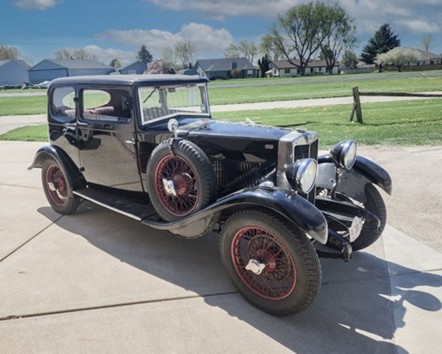
1927 MG 14/28 (“Milly Molly”), 1928 MG 14/40 (“Phillip”), and 1929 MG 18/80 Sport Saloon (“Frederick”)
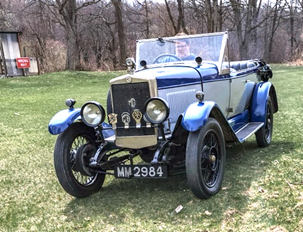
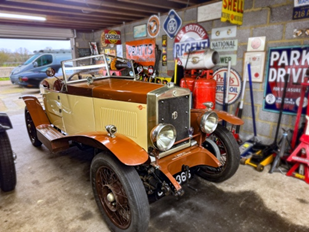
This MG 14/28 (aka Milly Molly) was titled as a Morris Oxford in 1927 and has been owned by five families. The car is very original, repainted only once. The 28 hp four cylinder side valve 1.8L engine is paired with a three speed gearbox, good for 60 mph. Total production for the years 1924-27 was approximately 290 with ten known survivors. MG launched the 14/28 Super Sports in 1924. It was the second line of cars assembled by Morris Garages in Oxford: a sales, repair, and assembly garage managed by Cecil Kimber and personally owned by William Morris. MG first fitted six Morris Oxford chassis with a two-seater body supplied by Charles Raworth & Sons of Oxford in 1923. The badge on the 14/28’s Bullnose radiator still read Morris Oxford. MG badges were not to appear on the radiators until 1927, but they did appear below the Morris badge on the last of the 14/28 cars which featured flat radiators. Oxford chassis were delivered from the Cowley factory, modified slightly, and the engine mildly tuned. They were then fitted with attractive aluminium paneled bodies painted in two colors.
MG 14/40 (aka Phillip) was built in 1928. It has been restored by acclaimed early MG historian and author P.L. Jennings. The 40 hp four cylinder side valve 1.8L engine has a three speed gearbox, and top speed of 65 mph. From 1927 to 1929, MG produced approximately 490 with 21 known examples remaining. The transition from the MG 14/28 to the MG 14/40 was primarily a marketing-driven development rather than a major mechanical overhaul, with the 14/40 being a further refinement of the 14/28.
MG 18/80 (aka Frederick) is a 1929 MK I production Salonette (one of two known to exist) built on the first MG designed chassis. The MG 18/80 stands at the threshold of MG’s identity: the first model to be designed entirely at Abingdon under Cecil Kimber, and the car that established the marque’s ambition beyond the light cyclecars of its origins. Produced between 1929 and 1933, the 18/80 was offered in two principal variants — the Mark I and the revised Mark II — with a combined production of only 736 examples and 33 known survivors. The 2.5L six-cylinder, overhead-camshaft engine delivered the performance promised by the name: 18 horsepower tax rating and a genuine 80 miles per hour in an era when such figures commanded respect.
Mark I’s came in Sport Saloon (Salonette) and Tourer versions. With its long open bonnet and swept wings, the Mark I embodied the sports car ideal that Kimber was articulating for the world. The Mark I Sport Saloon brought coach built refinement: a closed, luxuriously appointed body on the same mechanically accomplished chassis.
To encounter these three Vintage MGs together, in running condition, is an opportunity that simply does not arise at North American MG events. We encourage members to spend time with these cars and their owners Lt. Col. John William Yates Thornley, OBE (1909–1994) requires no introduction to members of this Register. He joined the MG Car Company in 1931 as an assistant Service Manager following his role as founding Secretary of the MG Car Club on October 12, 1930 — the club he had helped establish just months earlier after persuading Cecil Kimber to authorize the use of the MG octagon as its badge. He rose through the ranks of the Nuffield Organization and British Motor Corporation to become General Manager in 1952, and ultimately Director and General Manager — the position he held until his retirement in 1969.
It was Thornley who conceived of the MGB, who guided the Pininfarina-styled GT into production, who fought the corporate bureaucracy of BMC and later British Leyland with wit,
determination, and an unwavering belief in what Abingdon stood for. He remained a visible and beloved figure in the MG community until his death in 1994, frequently appearing at events in his distinctive blue MGB GT — fitted with V8 alloy wheels, an early chrome grille, a Borg Warner 35 automatic gearbox, and the coveted “MG 1” registration plate.
John’s son Peter is quick to note that “MG 1” was, in truth, his mother’s car — though John was rarely seen without it. It once served duty towing a garden trailer fashioned from a Mini rear subframe around the Thornley family garden in Abingdon: a detail that somehow only deepens its charm. MG 1’s current owner has generously agreed to bring the car to Sandusky. This may be the only opportunity many members will have to see it in person.
John Thornley’s MGB GT — Registration “MG 1”
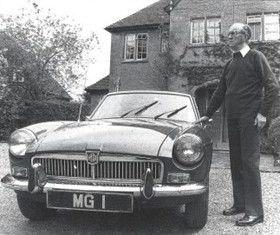
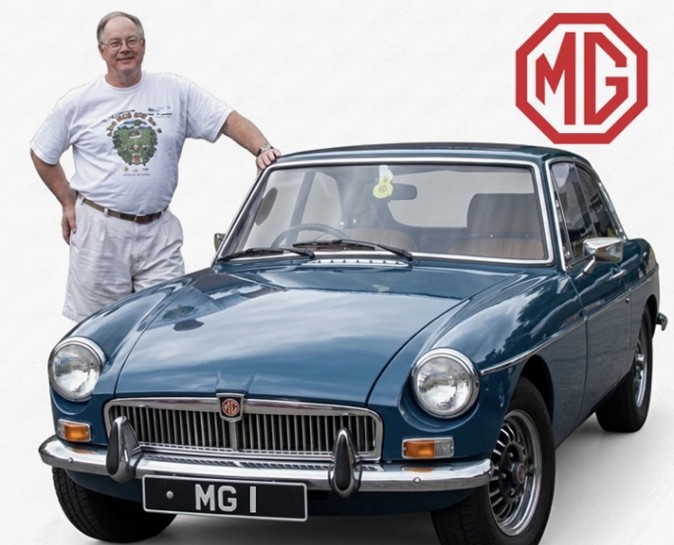
It was Thornley who conceived of the MGB, who guided the Pininfarina-styled GT into production, who fought the corporate bureaucracy of BMC and later British Leyland with wit,
determination, and an unwavering belief in what Abingdon stood for. He remained a visible and beloved figure in the MG community until his death in 1994, frequently appearing at events in his distinctive blue MGB GT — fitted with V8 alloy wheels, an early chrome grille, a Borg Warner 35 automatic gearbox, and the coveted “MG 1” registration plate.
John’s son Peter is quick to note that “MG 1” was, in truth, his mother’s car — though John was rarely seen without it. It once served duty towing a garden trailer fashioned from a Mini rear subframe around the Thornley family garden in Abingdon: a detail that somehow only deepens its charm. MG 1’s current owner has generously agreed to bring the car to Sandusky. This may be the only opportunity many members will have to see it in person.
MG EX 186 — The Abingdon Skunkworks Le Mans Prototype
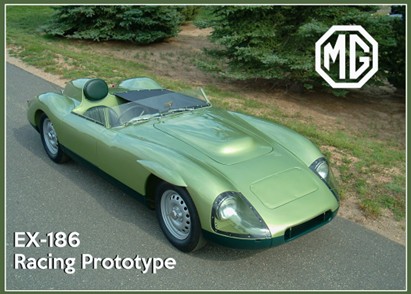
Among all the automobiles that have carried the MG octagon, EX 186 occupies a singular position: it is a car that should not exist. Standard MG practice was to destroy racing prototypes when their programs were cancelled a policy that claimed many extraordinary machines. That EX 186 survived is owed entirely to the ingenuity of one man: John Thornley himself.
The story begins in 1955 with MG’s three-car entry at Le Mans fielded at the last minute with prototypes featuring bodywork of the nascent MGA. The highest placed MG finished 12th overall and 5th in class, a remarkable result against machinery of far greater displacement and development. Thornley and Chief Designer Syd Enver saw in this result a proof of concept. Working in deliberate secrecy, because their parent company BMC had expressly forbidden MG from racing, they began development of a purpose-built Le Mans prototype, using the same team that constructed EX 181 the “Roaring Raindrop” which Stirling Moss drove to 245.6 mph at Bonneville in 1957, and Phil Hill to 254.9 mph in 1959, still the fastest MG ever recorded. Engineering drawings were dated as early as 1955; construction primarily occupied 1958 and 1959.
The result was EX 186: a handcrafted aluminum body of remarkable aerodynamic refinement, a twin-overhead-cam BMC B-Series engine, and a technically sophisticated De Dion rear suspension. The MG design team had EX 186 and the future MGB simultaneously on their drawing boards. MGB chief designer Don Hayter later said the De Dion axle and independent rear suspension were considered for the MGB, but cost considerations precluded either. EX 186 was a skunkworks project in the truest sense: conducted in secret, driven by passion, and ultimately cancelled before the car ever competed.
Rather than destroy EX 186, as was mandated by the executive offices at BMC, Thornley dispatched it to California in January 1961, invoiced to Kjell Qvale’s British Motor Car Distributors in San Francisco as “auto parts.” It sat in storage, then was briefly licensed for road use, then spent years in a barn on a walnut farm in Red Bluff, California. In 1982, Joe and Cathy Gunderson found it advertised in Road & Track, and began what became a decades-long, meticulous restoration to original specification. Earlier this year, the Gundersons won Best in Class at the prestigious Amelia Island Concours.
EX 186 is the only one ever built. It will be in Sandusky. You don’t get a chance to see important cars like this every year. You get it every five.
Stay with us at the beautiful Kalahari Resort — At a Rate You Won’t Find Anywhere Else
Registered attendees receive an exclusive rate of $189/night plus tax at the famed Kalahari Resort — with the $40/night resort fee waived entirely. The standard rate runs $229–$274/night. This rate is available only to registered MG International 2026 attendees.
Pre-Registration Discount Through July 14
Early registration is strongly encouraged. Pre-registration pricing holds through 12:01 am ET on July 15, 2026, after which fees increase by $25 per category. The online portal closes August 15, 2026; on-site registration will be available at Kalahari after that date, though ticket and meal availability cannot be guaranteed.
To register, visit: https://mginternational2026.regfox.com/register
For questions: info@mginternational2026.org
MG International 2026 is a joint production of the North American MMM Register (NAMMMR), the New England MG T Register (NEMGTR), the North American MGA Register (NAMGAR), and the North American MGB Register (NAMGBR) — the four organizations dedicated to the preservation, enjoyment, and fellowship of MG automobiles across North America
